Inspired by the NCX Group podcast episode EP 4 – Cybersecurity Impacts to Sustainability Revenue and Growth.
Most owners of a small shop, office or service company in Murrieta or Temecula think of security as an IT expense: something you pay for, like toner, and hope you never notice. That way of thinking made some sense fifteen years ago. In 2026 it gets the math backwards. Small business cybersecurity now decides whether you can keep the doors open after a bad week, whether customers and bigger partners will do business with you, and whether you can grow without inviting trouble. In other words, it is a revenue topic, not just a technology topic.
NCX Group made this argument years ago: security isn’t only the “IT guy’s” job, and every leader needs to understand how it connects to the health of the business. That idea has aged well. Here’s how it plays out for local businesses today, and what we recommend you do about it.
When we say “sustainability” here we mean staying in business. The threats that end small companies are rarely dramatic movie-style hacks. They are ordinary events: an employee opens a fake invoice, ransomware locks the one computer that runs the point-of-sale or scheduling software, or a criminal slips into the owner’s email and quietly redirects a vendor payment. For a business with five or twenty employees, a single week of downtime can wipe out a month or more of profit, and a large fraudulent wire transfer may never come back.
Attackers in 2026 also have better tools. AI-written phishing emails no longer have the broken grammar that used to give them away, and voice-cloning scams can make a phone call sound like your bookkeeper or your boss. Ransomware groups increasingly target small and mid-sized businesses precisely because they expect weaker backups and a faster payout. Resilience, meaning the ability to keep working and recover quickly, is what keeps a bad day from becoming the last day.
The bigger shift since that original episode is how often security shows up in the sales process. A few examples we see with clients around the Temecula Valley:
Put simply, customers buy from businesses they trust, and in 2026 trust includes “will this company protect my information and my money?”
Growth adds people, devices, apps and data, and each one is a new door. A new hire who reuses a personal password, a cloud app someone signed up for with a credit card, or a laptop that leaves with a former employee can all become the way in. Businesses that set up good habits early, while they’re small, find it far cheaper to grow than businesses that try to bolt security on after an incident.
Growth also tends to bring in money from lenders, investors or a future buyer. Anyone looking to finance or purchase a company now asks about its cyber posture, and a messy history of breaches or unmanaged systems can lower what the business is worth. Treating security as part of building value, rather than a cost center, pays off when that conversation comes.
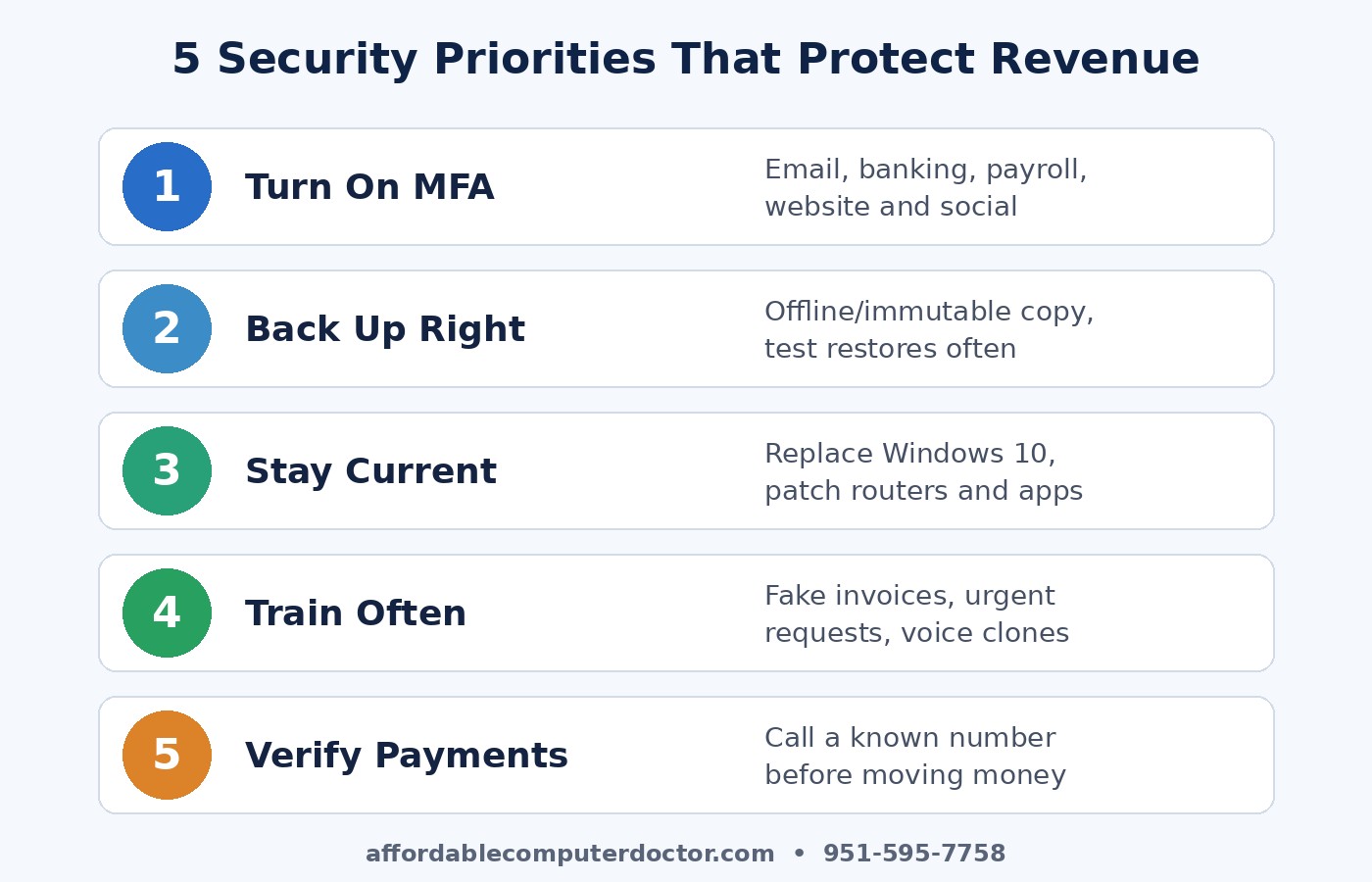
You don’t need an enterprise budget. For most small offices and home-based businesses in Murrieta, Temecula, Menifee, Wildomar and Lake Elsinore, these five steps deliver the most protection per dollar:
The owners who handle this well don’t become technical experts. They simply put security on the same list as cash flow, staffing and marketing. Once a quarter, ask a few plain questions: Which accounts would hurt us most if someone broke in, and are they protected with MFA? When did we last test a restore? Who still has access who shouldn’t? What would we do, and who would we call, if our main computer stopped working tomorrow morning? Writing the answers down turns a vague worry into a short plan.
Home users benefit from the same thinking. Your family’s photos, tax records and bank logins have real value, and the same steps (MFA, backups, updates and a healthy dose of suspicion about urgent messages) protect a household just as well as a storefront.
If you’d like help figuring out where your business stands, A. Computer Doctor can review your setup, from email security and backups to aging PCs and network equipment, and give you a plain-English list of what matters most for your budget. We work with small businesses and home users across Murrieta, Temecula, Menifee, Wildomar and Lake Elsinore. Call or text (951) 595-7758 to talk it through.
Credit: This article was inspired by the NCX Group podcast episode EP 4 – Cybersecurity Impacts to Sustainability Revenue and Growth (October 2017). The analysis and 2026 recommendations are our own.