Most small businesses in Murrieta and Temecula don’t fail at cybersecurity because they bought the wrong antivirus. They fail because security never becomes an actual program. A firewall gets installed, a password policy gets emailed once, someone promises to “look into backups,” and then the busy season hits. A year later, nothing has changed except the number of threats. A real cybersecurity program fixes that. It’s a short list of priorities, one person who owns them, and a habit of following through.
After years of cleaning up infected computers and hacked email accounts across the Temecula Valley, we’ve seen the pattern clearly. Two things separate the businesses that stay safe from the ones that get hurt: focus and execution. Here’s how to build both, even with a small team and a modest budget.
Security tools are only one piece. A program is the system that decides which tools you need, makes sure they’re configured correctly, checks that they’re still working, and adjusts when your business changes. Without that system, you end up with gaps nobody notices. Picture a backup drive that quietly stopped running six months ago, a former employee who still has email access, or a router that hasn’t been updated since it was installed.
Attackers don’t need to beat your best defense. They only need to find the one thing you forgot. That’s why consistency matters more than any single product.
Small businesses can’t do everything at once, and they shouldn’t try. Trying to fix fifty problems usually means fixing none of them. Narrow your attention instead:
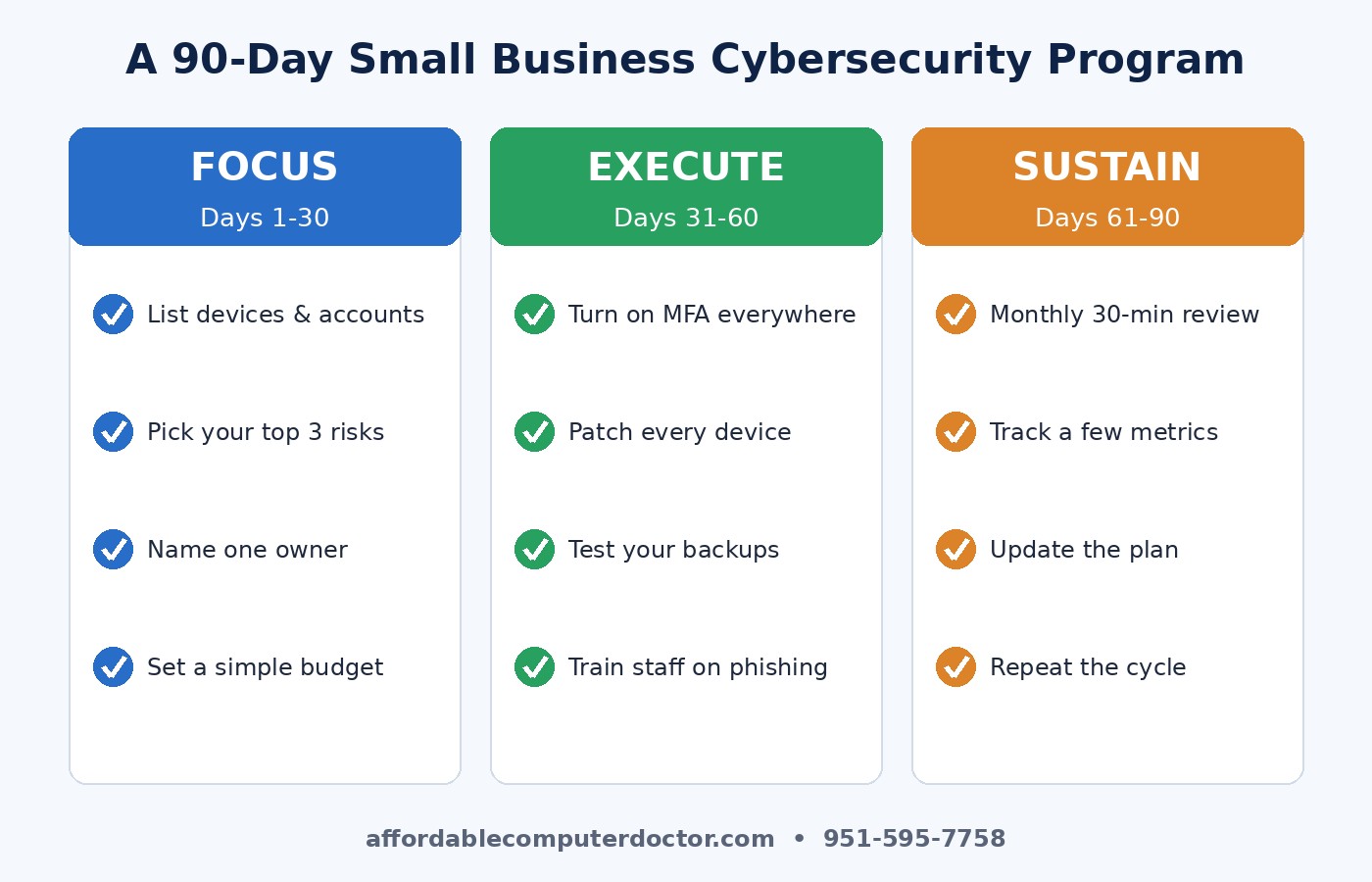
A plan only protects you once it’s carried out. These are the high-impact actions we recommend executing first, because they shut down the attacks we see most often in our shop:
Technology changes fast, and so do the tricks criminals use. The businesses that stay protected build a short, repeating rhythm into their calendar:
Track a handful of simple numbers. How many devices are fully patched? Is MFA on for every account? When was the last successful restore test? When those numbers move in the right direction, your program is working.
In a small business, security often falls on an owner or office manager who already wears five hats. Focus and execution require energy, and an exhausted person makes mistakes. Keep the workload realistic. Automate what you can, write down the steps so they don’t live in one person’s head, and hand off the technical pieces when they’re taking time away from running the business. Sustainable beats heroic every time.
Families have more at stake online than ever, from banking and medical portals to school accounts and smart home devices. The same three steps apply at home. Focus on your most important accounts, turn on MFA, keep devices updated, back up photos and documents, and check in on it every few months. A little discipline goes a long way.
A cybersecurity program doesn’t have to be complicated or expensive. It has to be focused on the risks that matter and executed consistently, month after month. Do that, and you’ll close most of the doors attackers rely on, long before they come knocking.
If you’d like help setting priorities or handling the hands-on work, A. Computer Doctor works with small businesses and home users across Murrieta, Temecula, Menifee, Wildomar, and Lake Elsinore to build practical security programs that actually get followed. Call us at 951-595-7758 to schedule a cybersecurity checkup.
Inspired by the NCX Group podcast episode EP 7 – Cybersecurity Focus and Execution.